Wednesday, 2 April 2014

Justin Trudeau: Just another “Con” man?

Posted March 2, 2014 by Will Dubitsky in Politics  (The Common Sense Canadian, March 2, 2014 http://commonsensecanadian.ca/justin-trudeau-just-another-con-man/)Justin Trudeau-Just another Con man
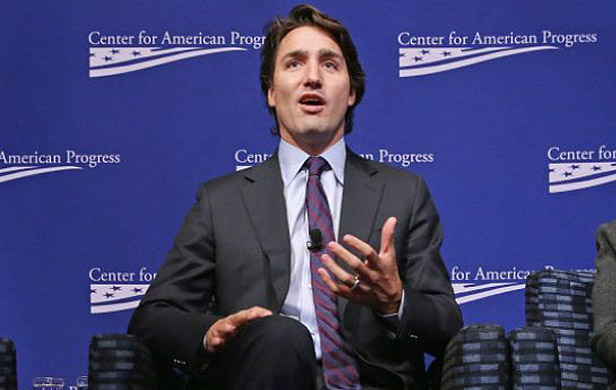
Justin Trudeau addresses a progressive think tank in Washington, DC (photo: Chip Somodevllla/Getty)
Justin Trudeau wants to project a young, fresh face, representing all the good things that Canadians want – a man who would do politics differently.  But the gap between reality and fairytale is extraordinary.
If one looks at what he has said to date, one finds a man with tired old ideas;  a limited understanding of, and sensitivity for, many major issues; and a puppet serving Bay Street, Big Oil and other powerful interests. The same powerful interests served by the Harper administration.

A middle class fairy tale

Most telling is Trudeau’s supposed concern for the middle class.  Though 80% of Canadians have seen their revenues decline or stagnate over the last 3 decades – income inequalities are at an all time extreme – Trudeau, like Stephen Harper, has concluded that low corporate taxes are the way to go for maintaining what they perceive to be a prosperous and rich Canada.
But Trudeau goes one step further to the right than Harper.  He has repeatedly expressed the view that now is not the time to lower the corporate tax rate, implying that, at a later time, a lower corporate tax rate could be an option.
To put all this in context,  the lowering of corporate tax began with the Liberals and was accelerated by the Conservatives.  The result is that: 1) At 15%, Canada has the lowest corporate tax rate in the G8; and 2) approximately $575B lies dormant in corporate liquidity.
Together, these factors imply that having the lowest corporate tax offers very few competitive advantages and that a better distribution of the wealth could be achieved with higher corporate taxes and fewer fiscal escape clauses/deductions.  The additional accrued revenues could be invested in economic development and regional diversification; youth employment; health; innovation for the jobs of tomorrow; public transportation and other urban infrastructure; day care -  to name just a few examples.
Further on this theme, Kevin Page, the former Parliamentary Budget Officer, concluded that a low corporate tax rate limits government manoeuvrability to that of austerity budgets.
In his own clumsy fashion, Trudeau has confirmed Kevin Page’s analysis in that he recognizes that the Liberal Party of Canada’s (LPC’s) own Harper-like policies on wealth distribution would produce Harper-like results. To be more specific, to prepare Canadians for such an eventuality, or the “necessity” of this Bay Street accommodation, Trudeau has indicated that the post election LPC budget could  very well be an austerity budget.
In other words, there is a disconnect between Trudeau’s supposed concern about the middle class and reality. In the absence of any serious attempt at redistribution of the wealth – something in which Trudeau appears not to believe in – he can only offer a middle class fairy tale.  This is a backdrop for many Trudeau’s positions on other issues.
No wonder Justin has described income splitting as “a decent idea”, even though 85% of Canadians would receive no benefit, while the majority of the top 1% of income earners would get $6500 and up.  So much for his preoccupation with the middle class.

Appeasing Big Oil, denying science

Turning to the environment, once again Trudeau has much more in common with Harper than most think, particularly when it comes to the denial of scientific evidence. It’s high time to debunk the myths about Trudeau’s “concerns” in this domain.
Trudeau’s position on Keystone XL is case in point.  According to Justin, the opposition to Keystone XL to transport tar sands bitumen to the US Golf coast is not based on scientific evidence.  Yet life-cycle emissions related to tar sands – from the extraction stage to the refining and production of major quantities of the by-product pet coke for use as a cheap, dirty fuel; and to the final consumption as fuels – place tar sands-derived substances in the range of 20% to 25% more emissions than those associated with conventional petroleum.
As if this extreme denial is not enough to put Trudeau in the same Big Oil camp as Harper, Trudeau has also complimented Premier Redford for promoting Keystone XL with references to Canada’s good environmental record!  Trudeau has been critical of Harper for not doing the same – despite Harper’s disastrous environmental legacy.
This is absolutely astounding!  After Harper’s dismantling of environmental protection legislation, weakening of the environmental impact analysis process, muzzling scientists, decimation of Canada’s environmental research capabilities especially as it relates to the impacts of climate change and the monitoring of Canada’s emissions, pulling out of the Kyoto Protocol,  and much much more, Trudeau, like Harper, perceives the environment as a PR challenge rather than a Mother Earth/humanity state of health challenge.
But the denial doesn’t stop there.  Trudeau bases part of his support for Keystone XL, as is the case with Stephen Harper, on the recent US Dept of State report which suggests that the environmental impacts pertaining to the approval of Keystone XL will be minimal.
Never mind that this report was written by authors close to the petroleum industry who concluded that if the US cannot import unrefined tar sands derivatives, the US would get it’s petroleum from elsewhere.
Never mind that a rejection of Keystone  XL would be a US and global game-changer, sending a clear signal to the globe that the US is serious about reducing its dependency on fossil fuels and will be looking to clean tech to address tomorrow’s energy needs.
Indeed, under these circumstances, it should come as no surprise that Trudeau did not distant himself from Jean Chrétien’s January 2014 remarks to the effect that it makes no sense to restrict tar sands development because we are going to need petroleum for a long time to come.

Falling behind Europe on emissions reduction, green economy

And the denial goes a notch higher when it comes to Trudeau’s views on national solutions to address climate change.  In keeping with the Liberals’ conciliatory legacy with Big Oil, this time, in reference to cap and trade, he claims that this environmental concept doesn’t have scientific merit. (Cap and trade is a model which penalizes companies that exceed their emissions limits and rewards companies that reduce emissions below their targets by being able to sell their credits to firms in the proceeding category.)
Never mind that Europe has had an Emission Trading Scheme (ETS) since 2005 and that the ETS has proven to be a potent compliment to other environmental policies. The results are such that at least 25 EU nations have been identified as likely to meet or beat the EU target 20% reduction of emissions by 2020, relative to 1990 levels.
Never mind that Germany has exceeded it’s Kyoto Protocol goal of a 21% reduction in emissions by 2012 with an achievement of a 25% reduction, all while having one the world’s strongest economies and a clean tech sector that has become bigger than the German auto sector.
Never mind that China has become the world’s largest investor in clean tech - with $67.7B and $61.3B invested in renewables in 2012 and 2013, respectively – and is now planning to introduce the first of seven pilot cap and trade schemes in Shenzhen.
As a former Government of Canada employee who worked in the field of sustainable development, it comes as no surprise that Trudeau’s “thinking” on Big Oil is both conciliatory and wishy-washy.  Emissions spiked up during the previous Liberal reign – as has been the case with the Conservatives at the helm.

The Liberals’ oil-friendly legacy

This LPC legacy was so because of, among other things: 1) the absence of effective legislative and fiscal measures; 2) the party’s continuation of generous subsidies for the fossil fuel sectors; and 3) a fossil fuel-friendly mindset as reflected in the Stéphane Dion proposal, prior to the Liberals’ defeat, to invest billions of government funds in the fossil fuel industry to help that “impoverished” sector reduce its emissions.
It is becoming increasingly evident that Trudeau is vague as to his environmental plans because of his alignment with Big Oil, a longstanding Liberal tradition.

Poor judgement, top-down leadership and Harper similarities

Further on the denial of science,  but in a different context, is the matter of the unusually long time – over a year – that it is taking for Health Canada to approve for use in Canada the drug  Mifepristone (a.k.a. RU-486), the abortion drug.  This, despite the fact that the drug has been in use around the world since 1988, when it was first approved in France.
Given the views on abortion of the minister in question, Rona Ambrose, the delays are suspect. But all Justin Trudeau could say on the exceptional delays is that he is not a medical expert.  Imagine the implications of him being in power with his weak judgement, when this is combined with his not wanting to upset Big Pharma and right wing groups.
Equally telling on Trudeau’s poor judgement and flippancy, was his “performance” on the Radio-Canada TV show Tout-le-monde-en-parle, on Feb 23, 2014.  The Ukrainian Ambassador to Canada, Vadym Prystaiko, quite aptly called for Trudeau to apologize for his “joke” on the show to the effect that Vladimir Putin would not be in a good mood to discuss the Ukrainian turn of events  because of the defeat of the Russian men’s hockey team in Sochi.  As the Ambassador said, 82 deaths in the clashes between security forces and the demonstrators is no laughing matter.

Trudeau’s lightweight Senate proposal

As for the Senate, I have saved this for near the end because I think we should go beyond the scandals of the moment, to the stuff that has implications for all Canadians. Let’s get real. The case has yet to be made as to why a different Senate, made up of unelected officials and appointed by another group of unelected officials, would improve Canadian democracy.  More important, with Senate retirements not mandatory until age 75, it means it would take at least two decades before this so-called different Senate would take shape.
Add to the Trudeau Senate cocktail the way in which he went about springing the news on “Independent” former Liberal Senators. Here one discovers Harper-style, top-down leadership, with no consultations outside a small inner circle. Due to the absence of internal consultation, Trudeau not only surprised Liberal Senators, but his entire caucus!  Or is this another case of poor and gratuitous judgement?

Justin opposes divisive politics – except when it suits him

While Justin Trudeau presents himself as a uniter, not a divider like Harper and Quebec Premier Pauline Marois, delegates at the Feb 2014 national convention in Montreal expressed the view that a Marois majority would help the party gain votes in BC and Ontario. In other words, the LPC hopes for a PQ majority in order to falsely represent the LPC in English Canada as the saviour of national unity. This is wedge politics that places party interests above national interests in order to target specific regional voters. This is the kind of traditional LPC trick that turns off Québécois.
No wonder only 10% of the LPC delegates at their convention in Montreal, Quebec were from Quebec.
During the orange wave in Quebec, the NDP gains were in part the result of former Bloc voters shifting over to the federalist NDP.  This is the way to unite Canadians, by presenting a progressive alternative for all parts of Canada – with the same themes/messages in every region of the country.

Trudeau and Harper: Other similarities

Finally, there are a host of other matters where we find Trudeau and Harper very much on the same page – such as Trudeau’s views that: 1) the sale of Nexen would pave the way for free trade with China and a more prosperous middle class; 2) health is primarily a management issue, rather than a financial challenge; and 3) guns are an integral part of Canadian culture.
Summing up the LPC policy positions to-date, it is clear is that Stephen Harper and Justin Trudeau are on the same Bay Street/Wall Street, Big Oil team.
Why would we expect anything different from Justin in 2015?

$1.9T Global Fossil Subsidy Bill: IN DEPTH by Christopher Hopson, Recharge News, Tuesday, April 01 2014


Phasing out these hand-outs would reduce CO2 emissions significantly and enable renewables to compete on a level playing field, while the money saved could be used to subsidise the transition to clean energy or help the world deal with a warmer planet. Currently, the richest countries are spending six times more on supporting fossil fuels than on helping poorer nations adapt to climate change, according to a London think-tank, the Overseas Development Institute (ODI).
"Think about it,” says Christine Lagarde, managing director of the International Monetary Fund (IMF). “We are subsidising the very behaviour that is destroying our planet, and on an enormous scale.”
While there is a worldwide consensus that this situation has to change, virtually nothing is actually being done about it.
Almost five years ago, the G20 countries committed to “phase out and rationalise over the medium term inefficient fossil-fuel subsidies while providing targeted support for the poorest”. But as Doug Koplow, from US environment group Earth Track, tells Recharge: “The problem is that the G20 leaders seem to get a discussion going on this subject at every summit meeting, but then they just seem to do nothing.”
One major problem seems to be that no-one can agree what constitutes a fossil-fuel subsidy, let alone an “inefficient” one.
danish_sawyer.jpgNew analysis by Washington-based think-tank Worldwatch Institute shows that global subsidy estimates range from $544bn to $1.9trn a year, depending on how a subsidy is defined and calculated — whether it includes tax breaks on production, direct subsidies to consumers, or harder-to-quantify “externalities".
Many governments simply do not know how much they are spending on subsidising dirty fuels, as many forms of support have never been quantified, according to the International Institute for Sustainable Development’s Global Subsidies Initiative. Where information does exist, it is scattered across different ministries, as well as across regional and local governments, and is rarely made publicly available.
These problems are exacerbated in developing countries by poor budget transparency and limited resources for data gathering and estimating subsidies. “The resulting gaps in the data collected on fossil-fuel subsidies make it difficult, if not impossible, to assess or rationalise them,” says ODI research fellow Shelagh Whitley.
But the biggest stumbling block to ending the subsidies is undoubtedly the unwillingness of politicians to act — and that is largely due to the power and influence of Big Oil and Big Coal.
“The fossil-fuels industry is the most powerful vested interest in the history of the world,” says Steve Sawyer, secretary general of the Global Wind Energy Council. “It runs and/or owns many governments; and exerts a huge influence on many more.”
Politicians around the world rely on donations from fossil-fuel corporations. In the US, where election campaign costs can be eye-wateringly high, politicians of both main parties routinely accept thousands of dollars from these companies. In the current Congress, $8m has so far been accepted by House representatives, with 84% going to Republicans, while more than $3m has gone to Senators — 67% of which went to Republicans, according to US advocacy group Oil Change International.
subsidy_panel.jpgTo remove production subsidies, Congress would have to pass legislation to eliminate 12 preferential tax provisions related to coal, oil and gas. Efforts to remove even small portions of these subsidies have been resoundingly defeated in Congress, with lawmakers’ arguments echoing those of the lobby groups — that removal of tax breaks and other indirect subsidies would harm the economy.
“Punishing energy companies by raising taxes is not sound policy and could lead to less energy, less government revenue and fewer jobs,” says Jack Gerard, head of lobby group the American Petroleum Institute.
“The oil and gas industry in the US contributes $85m a day to the federal government — a larger contributor of government revenue than any other industry in the US.”
So although President Barack Obama has repeatedly called for an end to fossil-fuel subsidies — as he did in his State of the Union speech in January — he can’t actually get such a move through Congress.
As former US vice-president Al Gore says: “American democracy has been hacked. The US Congress... is now incapable of passing laws without permission from the corporate lobbies and other special interests that control their campaign finances.”
The fear at what might happen if subsidies are removed is palpable. Rising oil and energy prices may raise bills for voters and businesses that are already struggling. The same arguments are being used against carbon taxes.
But according to the Treasury Department, removing subsidies would reduce US oil production by less than 0.5%, and increase exploration and production costs by less than 2%. As it is the global market that determines oil prices, the impact should be negligible.
David Lipton, first deputy managing director at the IMF, says: “Subsidy reform can lead to a more efficient allocation of resources, which will help spur higher economic growth over the longer term.” Removing energy subsidies can also strengthen incentives for R&D in energy-saving and alternative technologies, he adds.
Fatih Birol, chief economist at the International Energy Agency (IEA), says fossil-fuel subsidies are “public enemy number one to sustainable energy development”.
“One of the main arguments put forward for keeping fossil-fuel subsidies is that they protect the poor, but studies show that 80% of such subsidies go to middle- and high-income households,” he adds. “The IEA is doing its best to persuade the G20 group of countries to act on this issue.”
Sawyer believes a “level playing field” created by removing all fossil-fuel subsidies globally would offer major advantages for renewables, as it would better reflect the true cost of energy generation. “As the price of fossil fuels rises, it would give low-cost renewables an ever-greater market advantage,” he says.
Thomas Becker, chief executive of the European Wind Energy Association, adds: “We in the wind industry can live without subsidies, as long as other energy sources don’t get subsidies as well.”
Fossil-fuel companies are quick to claim that renewables are only economically viable due to government subsidies, but the cost of green energy is dropping rapidly. According to Deutsche Bank, solar power is cheaper than grid electricity in ten major markets, including Italy and India, while wind energy is less expensive than other sources in countries such as Brazil and Australia.
Despite the political impasses, there are some chinks of light on the horizon, with important global bodies such as the UN, IMF, OECD and IEA all making increasingly strident calls for change.
The G20 leaders have asked their finance ministers to provide reports on the issue by the next G20 meeting in Brisbane, Australia, in November, and a European Commission report on the subsidies is expected in September.
subsidy-definitiion.jpgUN secretary-general Ban Ki-moon’s climate change summit, also in September, is seen as a key opportunity for world leaders to make specific pledges as to how they will replace fossil-fuel subsidies.
“Previous meetings identified a range of barriers to sustainable investment,” says Ban. “These include what we call ‘perverse subsidies’ [and] uncertainty about the predictability of electricity tariffs or government energy policies. We have to break down these barriers.”
Any deal to remove fossil-fuel subsidies would require agreement from the three biggest fossil-fuel supporters — the US, Russia and China, which rarely agree on anything.
Precise data is hard to extract from China, where producer subsidies can be found at the state, provincial and local levels. However, China is slowly trying to address its pollution problems by gradually reducing preferential tax treatment for fossil-fuel companies.
Russia, however, is offering ever more generous tax breaks to the oil and gas industry as it attempts to exploit its Arctic resources. President Vladimir Putin uses energy as a tool of international power — the threat of switching off Russia’s gas supply to Europe seems to be one of the key reasons for the EU’s feeble response to the Crimea crisis. Anything that weakens Russia’s fossil-fuel supply will weaken its power, at least in Putin’s mind.
But with the West and Russia at loggerheads over Crimea, the chances of a G20 or global deal look slimmer than ever. Some leaders have already indicated Putin might not be welcome at the Brisbane meeting. The issue may be kicked into the long grass.
“If there’s anyone around to write the history of the 21st century,” says Sawyer, “some of the key questions that will be asked are, ‘why did it take so long to address the climate change threat?’; and ‘why weren’t the deliberate misinformation campaigns from the fossil-fuels industry — about climate, renewables and economics — exposed much sooner?’.
“I believe one day they will be seen as the greatest crimes against humanity in human history. I hope I live long enough to see the trials begin; and I hope I live long enough to see politicians with the courage to take them on.”
Click here for the full list of the world's biggest fossil-fuel subsidisers

The biggest fossil-fuel subsidisers

These comprehensive figures, compiled in 2013 by the International Monetary Fund, show the amount of petroleum, natural-gas, coal and fossil-fuel-electricity subsidies in 2011, including consumption and production subsidies, as well as externalities, such as the cost of climate change ($25 per tonne of carbon), pollution, traffic congestion, accidents and road damage. All figures in US dollars.
1 United States 502,137,390,000
2 China 279,480,451,000
3 Russia 116,256,840,000
4 Saudi Arabia 99,820,324,000
5 Iran 85,420,106,000
6 India 81,494,157,000
7 Japan 46,022,197,000
8 Indonesia 45,341,690,000
9 United Arab Emirates 33,596,288,800
10 Venezuela 32,892,198,600
11 Egypt 32,403,550,500
12 Mexico 27,576,633,000
13 Australia 26,502,896,000
14 Canada 26,384,745,000
15 Algeria 26,368,445,800
16 Germany 21,575,345,000
17 Malaysia 20,750,286,000
18 Ukraine 19,297,782,400
19 Kuwait 18,981,921,000
20 Iraq 18,485,513,200
21 South Africa 17,370,080,000
22 Korea 16,726,157,500
23 Thailand 16,339,161,000
24 Uzbekistan 14,802,311,700
25 Qatar 14,636,753,000
26 Kazakhstan 12,945,962,000
27 Pakistan 12,851,909,300
28 Argentina 12,837,700,800
29 United Kingdom 10,925,897,000
30 Poland 10,789,790,100
31 Taiwan 9,852,152,200
32 Nigeria 8,724,936,300
33 Turkmenistan 8,589,734,800
34 Bangladesh 7,943,721,500
35 Oman 7,860,598,000
36 Turkey 7,541,360,000
37 Italy 7,500,386,000
38 Chile 6,873,219,600
39 Ecuador 6,697,803,800
40 Spain 6,273,184,000
41 Vietnam 6,138,846,800
42 Brazil 5,049,142,000
43 France 4,685,574,000
44 Libya 4,507,338,110
45 Netherlands 3,945,092,000
46 Bahrain 3,838,103,000
47 Czech Republic 3,526,476,500
48 Lebanon 3,299,971,400
49 Azerbaijan 3,288,028,700
50 Singapore 3,190,699,200
51 Morocco 3,181,416,500
52 Yemen 3,175,091,400
53 Angola 2,974,461,100
54 New Zealand 2,954,479,100
55 Hong Kong 2,859,305,000
56 Jordan 2,804,893,600
57 Tunisia 2,616,574,900
58 Trinidad and Tobago 2,309,683,000
59 Luxembourg 2,207,002,600
60 Belarus 1,894,817,400
61 Ghana 1,869,953,800
62 Romania 1,835,227,800
63 Austria 1,746,234,500
64 Philippines 1,658,057,800
65 Sri Lanka 1,653,371,700
66 Zimbabwe 1,609,970,900
67 Greece 1,569,709,900
68 Israel 1,569,570,800
69 Belgium 1,544,597,500
70 Sudan 1,447,790,000
71 Brunei 1,376,218,700
72 Hungary 1,353,061,800
73 Bolivia 1,343,549,800
74 Bulgaria 1,308,705,100
75 Cameroon 1,269,337,500
76 Serbia 1,224,565,300
77 Colombia 1,221,069,900
78 Ireland 1,070,636,500
79 Finland 1,053,740,100
80 Zambia 952,078,070
81 Slovakia 950,785,400
82 Sweden 942,040,500
83 Peru 881,500,400
84 Denmark 858,849,000
85 Kyrgyzstan 836,767,900
86 Ivory Coast 805,316,800
87 Congo 684,512,700
88 Mozambique 680,946,600
89 Panama 678,662,500
90 Portugal 633,802,600
91 Bosnia 631,439,400
92 Estonia 625,265,300
93 Ethiopia 615,454,200
94 Tanzania 589,420,400
95 Myanmar 498,641,000
96 Guatemala 496,030,900
97 Norway 493,704,700
98 Switzerland 452,377,300
99 Slovenia 422,515,400
100 Mongolia 397,038,300
101 Senegal 386,981,200
102 Equatorial Guinea 367,405,500
103 Croatia 341,815,700
104 Botswana 303,626,800
105 DR Congo 296,467,600
106 Uganda 251,844,400
107 Kenya 231,219,900
108 Armenia 214,977,400
109 Lithuania 210,848,600
110 Tajikistan 193,813,800
111 Georgia 177,430,700
112 El Salvador 171,389,700
113 Benin 158,751,500
114 Dominican Republic 153,095,600
115 Latvia 146,415,600
116 Macedonia 145,601,000
117 Cyprus 144,822,200
118 Madagascar 138,045,600
119 Costa Rica 132,507,000
120 Gabon 127,525,500
121 Burkina Faso 124,585,500
122 Mali 120,806,900
123 Malawi 119,951,200
124 Moldova 116,710,100
125 Bahamas 109,164,000
126 Mauritania 103,023,500
127 Namibia 78,253,200
128 Honduras 75,230,600
129 Jamaica 65,179,200
130 Nepal 50,277,800
131 Cape Verde 48,869,300
132 Afghanistan 42,234,300
133 Maldives 29,763,200
134 Togo 26,452,600
135 Guyana 25,829,500
136 Rwanda 24,451,900
137 Lesotho 24,122,600
138 Niger 21,850,900
139 Bhutan 18,291,600
140 Barbados 18,109,200
141 Antigua and Barbuda 17,624,400
142 Iceland 15,498,800
143 Sierra Leone 13,152,000
144 St Lucia 10,112,900
145 St Kitts and Nevis 8,541,600
146 Grenada 7,885,000
147 Djibouti 7,206,800
148 Malta 6,470,300
149 Uruguay 6,375,700
150 St Vincent and
the Grenadines 5,715,400
151 Dominica 5,461,500
152 Fiji 5,048,800
153 Albania 2,991,400
154 Chad 1,772,600
155 São Tomé and Príncipe 1,467,100
156 Kosovo 1,166,300
157 Nicaragua 492,500
158 East Timor 287,400
159 Cambodia 179,100
160 Montenegro 78,900 

Total 1,894,826,364,880

Wednesday, 12 March 2014

QC 2014: Boussole électorale/Electoral Compass

Part I
The single question on the environment is a leading/propaganda question reinforcing unfounded perceptions. -- something I would expect from the Big Oil lobby but not Radio-Canada. Environmental choices do not necessarily mean spending more but rather changing the economic paradigms which can be done via government policies.  For example wind energy is competitive with other forms of resourced based energy.

The other important element is that the clean tech sector is among the highest growth and highest job creation sectors in the world.  There are 3.5 million jobs in the European green sectors, 1.2 million in renewables now, today.  Investments in clean energy in China were $61.3 billion and $67.7B in 2012 and 2013 respectively. The German clean tech sectors employ more people than the German auto sector.
http://ec.europa.eu/commission_2010-2014/hedegaard/headlines/articles/2014-01-06_01_en.htm
http://commonsensecanadian.ca/germany-shows-thriving-green-economy-possible/
http://commonsensecanadian.ca/chinas-chaotic-migration-green-economy/
http://commonsensecanadian.ca/europes-big-leap-renewable-energy-climate-action/

The $1.4B spent on Canadian subsidies for the oil and gas industry  generates 2300 jobs while the same amount invested in the green economy would support 18000 jobs. http://bluegreencanada.ca/node/175

In short there are basic economic questions here, a resource-based economy versus a clean tech economy.  Quebec and Canada are very much behind in this regard and most of its people operate in total ignorance that with each year, we fall further behind China, the European Union and the US.

If the ivory tower university types do not understand economic paradigms then they should not be forming questions on the subject -- which in the end reflects ignorance.

Part II
More generally, the questionnaire is poorly designed covering a miniscule spectrum of issues in simplistic forms, often reformulating questions in a repetitive fashion.

What the boussole does not show, for example, is the vacuum in the political choices offered.  I would like to vote for a strong team of federalist progressives but no such party exists in Quebec at this moment.  The Boussole absurdly indicates I am closest to the PVQ and QS but I do not want to vote for single issue party with a weak palette of candidates nor for an independentiste party that has progressive values but is weak on progressive solutions.

If this questionnaire was properly designed it would illustrate that a very large portion of Québécois do not like any of the choices offered.  I know more people in this category than any other.

Relating questions to  what each party's platform offers cannot address one of the most critical considerations, which is credibility.

The economic social and environmental challenges are all interrelated but one gets the feeling that those who designed the Boussole are disconnected, that is know too little about these inter-relationships to ask meaningful questions.

Part III
The economy and job creation, also linked with Part I, stands out for its absence. What kind of economy do people want? Conversely, the identity matters could be covered with one question.  As well the term identity has been simplified and hijacked by one party, the PQ and thus posing the questions in the way done by the Boussole is a leading question. The PQ definition of identity - relating it to religious symbols --  was not on the radar screen of Québécois until the PQ engaged in its malicious propaganda circus.

Part IV
For several questions, none of the answers provided applied, but "none of the above" was not provided, thus generating misleading results.

Conclusion

The boussole 2014 is full of leading questions and poorly thought out.

Friday, 21 February 2014

Atlantis gets EU cash for tidal push: By Darius Snieckus in Bristol Recharge News Thursday, February 20 2014

Atlantis gets EU cash for tidal push


The funding, awarded under the Seventh Framework programme for research and technological development, will underpin design, installation and operation of the company’s 1.5MW AR1500 tidal energy turbines in the 3.5 sq km Inner Sound project site, where tidal current races through at over four metres per second.
“The award of this grant ... will help to catalyse the [tidal] industry’s development, providing a credible and robust transition pathway from single turbine demonstration units, to the deployment of multi-hundred turbine arrays in Europe and across the wider international market,” says Atlantis chief executive Tim Cornelius.
The EC grant comes on the heels of Atlantis entry onto the London Stock Exchange’s Alternative Investment Market and £12m initial public offering (IPO).
“Taken with the £12 million that we have raised through IPO, this grant means that the business is in a strong financial position to deliver its projects,” Cornelius adds
The capital raised through the IPO is earmarked for the delivery of the first stage of MeyGen – a lead-off 9MW pilot project, planned as a stepping stone to an 86MW array – as well as for final detailed design of the AR1500 turbine and a demonstrator project planned off China.
Installation of the first six Atlantis turbines at MeyGen would begin early next year, with switch-on expected to follow “in late 2015 or early 2016”.
Last September, US military industrial giant Lockheed Martin inked a global partnership deal with Atlantis to bring the latter’s new 1.5MW turbine system to market, with an eye on deliveries to MeyGen, at the Force centre on Canada’s Bay of Fundy and India’s Gulf of Kutch.
Atlantis’ 1MW AR1000 turbine, a three-bladed machine standing 22.5 metres tall, weighing 1,500 tonnes and outfitted with an 18-metre-diameter rotor and permanent-magnet generator, has been put through its paces at the European Marine Energy Centre in the Scottish Orkney Islands and test-bench trialled at the National Renewable Energy Centre at Blyth.

Tuesday, 18 February 2014

Fossil Fuel Priests: Jeremy Leggett Recharge News Nov 4, 2013

Five thousand delegates from more than 100 countries file into a cavernous convention centre in Daegu, South Korea, for the World Energy Congress 2013.
A huge screen above them in the foyer is filled with a spinning globe, that blue pearl in space that we call planet Earth, along with some writing: “Nature has provided our energy needs for thousands of years. As we make the choices to meet our future energy needs” — the camera dives in to pan across sweeping rainforests — “nature is relying on us.”
Readers of the Intergovernmental Panel on Climate Change report by hundreds of the world’s best climate scientists would know for sure what nature is relying on us to do. Cut out the burning of fossil fuels, all the way to zero, by 2050 at the latest, beginning well within this decade. Otherwise we risk destabilising the climate, ending access to clean water and viable agriculture for most of us, collapsing civilisation in the process.
But most people at this congress share a deeply entrenched belief system. They are essentially priests within a kind of religion that is built around the burning of fossil fuel.
The first speaker, Saudi Aramco chief executive Khalid Al-Falih, is typical of many who will follow him over the week. “The Earth is blessed with a colossal endowment of fossil fuels,” he intones. Fossil fuels are the “crown jewels” of the world’s energy mix. We have 50 years of oil supply and 250 years of gas. And we must let market forces decide how much of it we use. He does not mention climate change, or the message on the giant screen outside.
Others are less comfortable ignoring the message, and so invent a mythology around it, in the way religions so often do.
A relaxed GDF Suez boss, Gérard Mestrallet, sits on a stage, being interviewed by a journalist who is unprepared to ask any hard questions. Mestrallet explains why he wants the US shale-gas boom exported across Europe, including to his own country, France, which has foolishly banned it. In parallel, he and the chief executives of nine other European utilities want to see subsidies for renewables ended. Why do they want this? “We are for the security of Europe,” he says. “We are for the climate.”
The journalist does not ask how he thinks such a proliferation of gas can lead to the end of fossil-fuel burning less than four decades from now. He does not ask how cutting renewables subsidies can be “for the climate”.
leggett-quote.jpgHad the uninquisitive journalist asked about the climate implications of all this gas, Mestrallet would doubtless have responded that burning gas creates fewer emissions than burning coal, which would have been true. But he would have omitted the worries about fugitive emissions of gas all the way from the well head to the home that cancel out the advantage of gas over coal. Big Energy bosses usually do. He would have dodged the issue of all the investment flowing to gas depressing the development of renewables. Big Energy bosses are good at that too.
The World Energy Council’s latest scenarios, published during the congress, offer a window on the dysfunctional group-think at work.
The “Jazz” scenario envisages total primary energy increasing by 61% to 2050, amid little multilateral effort to co-ordinate fossil-fuel reductions. The “Symphony” scenario envisages an increase of 27%, with a degree of policy co-ordination. In 2010, fossil fuels provided 79% of the world’s primary energy. Their share by 2050, by which time climate scientists tell us they must be phased out, would be 77% in the Jazz scenario and 59% in the Symphony scenario. In both scenarios, gas expands significantly from its current share.
And the climate implications? The target set by the EU is a 2°C temperature increase. A likely chance of staying below that requires returning CO2 equivalent concentrations below 400 parts per million (ppm). At present the figure is more than 420ppm. The Jazz scenario would take us to 590-710ppm of CO2 equivalent. The Symphony scenario would take us to 490-535ppm. Both would torpedo civilisation.
The top 20 European utilities, including GDF Suez, were worth $1trn in 2008. Today they are worth half that. The growing success of renewables, plus their own mistakes and oversights, have done this to them.
These are dying companies, with unworkable business plans. They should be embracing renewables with open arms, but instead seem set on a last ferocious assault on them. Their inculturated, institutionalised belief system compels them to do this.
All the evidence for this article can be found at www.jeremyleggett.net
Jeremy Leggett is founder and non-executive chairman of international PV company Solarcentury. His new book, The Energy of Nations: Risk Blindness and the Road to Renaissance , is published by Routledge

Wednesday, 12 February 2014

320MW UK tidal lagoon advances: Recharge News Feb 7, 2014

How the lagoon could look


The 320MW Swansea Bay project, which would generate energy using an 11.5km2 walled coastal inlet in which incoming water is trapped and later released through turbines, would be the largest tidal power plant in the world, supplying power for over 120,000 homes.
“Until now, tidal energy has been heavily promoted by governments and environmentalists as an intuitive source of clean and reliable energy for our island nation, but the business response has focused on relatively small-scale tidal stream devices,” says TLP chief executive Mark Shorrock.
“Tidal lagoons offer renewable energy at nuclear scale and thus the investment of hundreds of millions of pounds in UK industries and coastal communities.”
The £750m project, which could be online by 2018 flowing baseload electricity for up to 16 hours each day using ebb and flood tides, would also save more than 200,000 tonnes of CO2 annually over its 100-year design life.
TLP, based in Cheltenham, UK, has the backing of a consortium made up of international power technology giants GE, Alstom, Andritz and Voith, along with engineering consultancy Atkins Global, Dutch offshore dredging specialist Van Oord, textile technologist TenCate and UK construction contractor Costain.
Infrastructure conglomerate Macquarie has signed up to lead the capital financing of the Swansea Bay project.
Atkins Europe chief executive David Tonkin states: “The tidal lagoon concept represents a bold new addition to the energy mix. It is a great example of how innovative engineering could be used to harness our natural resources and provide clean, sustainable and predictable power for thousands of homes.
Swansea Bay is seen as well-suited to a tidal lagoon project, as the site is in shallow water but with a tidal range of more than ten metres. It is also close to several population centres in England and Wales, minimising electricity transmission losses during export.
TLP’s longer-term plan is to construct five or more tidal lagoon power plants inside the next decade, with a view to supplying 10% of the UK’s domestic energy.
“Economies of scale bring immediate advantage.  A second lagoon will require a lower level of support than offshore wind, for a renewable power supply that is both long-lived and certain,” states Shorrrock. “A third lagoon will be competitive with the support received by new nuclear, but comes without the decommissioning costs and safety concerns.
“Had we invested in tidal lagoons in the 1980s, by now, and into the next century, we would be generating cheaper power than any other form of supply.”
A decision from the UK government on the project is expected in 2015.
Large-scale tidal-range power plants are in operation at La Rance in France (240MW); Sihwa in Korea (254MW); and Annapolis in Canada’s Bay of Fundy (30MW).

Friday, 7 February 2014

THE EUROPEAN POLICY REVIEW ON 2030 GREENHOUSE GAS, RENEWABLE ENERGY AND ENERGY EFFICIENCY TARGETS


This article is dedicated to 1) the achievements and progress of the European Union (EU) on greenhouse gas (GHG) reductions and clean energy; 2) ongoing EU deliberations on 2030 emissions, renewables and energy efficiency targets; and 3) what this means for Canada. 

Specifically, the EU being the global leaders on a migration to a green economy, with its Emissions Trading System (cap and trade scheme) having been launched as far back as 2005, Canada has much to learn from the current and future EU debates on 2030 targets.  These EU discussions are particularly pertinent for Canada in light of a need to review Canadian fast forward green economy catch-up options following the next federal election in 2015.

2020 Targets and Progress on the Migration to a Green Economy
To begin, the foundations for the discussions on 2030 targets are the binding EU 2020 targets.  These targets entail:
·        -  a 20% reduction in EU greenhouse gas emissions from 1990 levels;
·        -  raising the share of EU energy consumption produced from renewables to 20%; and
·        -  a 20% improvement in the EU's energy efficiency.

Under this system, each country has its own binding national targets based on its relative capacities to contribute to EU-wide goals. 

In the case of Germany, for example, it had already reduced its emissions by 25% in 2012, thereby exceeding its Kyoto 2012 target of a 21%, all while being one of the world's strongest economies.  These facts are contrary to what Stephen Harper would have us believe to the effect that the economic development and sustainable development are opposing forces for which there can be no reconciliation.

Indeed, measured in terms of economic impacts, the EU progress to-date is staggering, especially with respect to job creation.  There are presently 3.5M people employed in the EU green sectors and the sector's job growth, for the 1999 to 2008 period, was 180,000 new jobs/year.  Even during the worst of the EU economic crisis, most of these jobs were retained and many more were created.

The EU renewable energy related jobs comes in at 1.2M in 2012 and the projection for 2020 is  2.7M.  With the right policies, this could reach 4M jobs by 2030.

The European Commission's White Paper
Against this backdrop, to initiate EU discussions on 2030 targets and build on the momentum of the 2020 goals, the very conservative and corporate friendly European Commission took up the task of producing a White Paper for release on January 22, 2014.  

In the months preceding the publication of the White Paper, a major debate arose among EU member nations as to whether 1) there should be 2030 binding triple targets, EU-wide and nation-specific, and in keeping with the precedent set with the 2020 triple goals or 2) simply have a stand-alone binding GHG reduction target to eventually be accompanied by state-specific GHG targets.  In its White Paper of January 22nd, the European Commission came down in favour of the second option.

The White Paper called for a 40% GHG reduction target with binding requirements for EU member states and an "at least" 27% renewables goal that would be binding on the EU but not binding on the Member States individually. 

Under the European Commission's formula, not only would an EU-wide binding renewable energy target be difficult to enforce in the absence of a binding renewables target for each nation, but also the 27% renewables target would reduce by one third the momentum set by the 2020 goals.  That is, modeling of the 40% GHG reduction target suggests that the 27% renewables portion of the EU-wide energy supply would be achieved anyway without the Commission's renewables target.

Debates within the EU: 8 Countries Favour Nation-specific Binding Clean Energy Goals While the UK and Poland Resist
The aforementioned Commission's position went against the recommendations submitted in letter dated January 2014, from the energy ministers of Austria, Belgium, Denmark, France, Germany, Ireland, Italy and Portugal, written to commissioners Connie Hedegaard,  the commissioner for climate action, and Gunther Oettinger, the commissioner for energy, in support of a binding clean energy goals for every EU nation.  The letter stated that such an approach is essential to providing the renewable sector with the certainty it needs for long term cost-effective investments.  Sigmar Gabriel, the German Minister of Economics and Energy, indicated that the extraordinary progress achieved to-date, and as alluded to above, would have not been possible without the combination of nation-specific binding GHG and renewable energy targets.

Particularly on the minds of those supporting binding renewables target is the fact that the EU is the part of the world which is most dependent on imported fossil fuels.  In 2012, EU spent $740B on importing these fuels.  Accordingly, the International Energy Agency has described the path to reducing this dependency as being that of greater reliance on domestically produced clean energy and greater energy efficiency.

In this confrontation of positions, it is the UK, in particular, that has been very vocal in opposing a renwables target because it wants to have the flexibility to include nuclear;  carbon capture and sequestration (CCS); and fracking technologies in its energy strategy.   Consequently, the UK has been advocating a 50% GHG target without renewables targets. 

Fittingly, Oliver Krischer, German MP from the opposition Green Party, said proposals to scrap binding renewable energy and energy efficiency targets for 2030 are intended to initiate a renaissance of nuclear power and push through fracking and CCS activities through the back door.

Another big obstacle to a renewables binding target at national levels, is Poland for which coal represents 90% of electrical its power generation.


The European Parliament Votes in Favour of Triple and Binding 2030 Targets
Consistent with the aforementioned debates within the EU, on February 4, 2014 Members of the  European Parliament in a plenary non-binding vote, voted 347 to 308  in favour three binding targets on national levels, a 40% reduction in GHGs; a 30% target pertaining of energy to come from renewables; and a 40% improvement in energy efficiency.  This MEP February 2014 vote is consistent with the recommendations of the European Parliament's Environment and Industry Committees on a three-targets binding approach.

According to the European Wind Energy Association, the 30% binding renewables targets for EU member states could provide 570,000 new jobs and save $818B in imports of fossil fuels, all while lowering energy costs for energy-intensive industries.

Next Steps
The MEP vote notwithstanding, it is just one step in a very lengthy process leading up to final legislation in 2017.   Moreover, the vote in the European Parliament does not require that member states to approve national binding targets.

On February 19, 2014, there will be a Franco-German summit on energy cooperation.  On March 4, 2014 the EU energy ministers will meet.  This will be followed by a European Council meeting of heads of state on March 8-9, 2014.

Further down the road, European Commission commissioners will be replaced in 2014 and firm legislative proposals are not expected before 2015, after the European parliamentary elections.  Subsequently, it may take about two years before the final policies become EU law.

Adding to the cocktail of views that will contribute to the above-described debates are the positions of clean tech sector stakeholders adamantly in favour of national binding renewables targets.

Taken together, the EU discussions on the pros and cons of different 2030 options could prove to be enlightening for Canadians reviewing options to catch up to the Europeans, who are already way ahead of Canada on the migration to a green economy.  As well, their successes and failures to-date in advancing their respective countries offer models for consideration for Canada.   Accordingly, as a contributor to The Common Sense Canadian, I will continue to provide articles on new EU green economy developments.

Lastly, it is worth noting that the February meeting of the European Parliament included a vote in favour of extending the EU Fuel Quality Directive beyond 2020, thus banning tar sands imports to the EU indefinitely, likely to the great displeasure of Stephen Harper with respect to his free trade objectives with Europe.