Sunday, 18 May 2014

Australia Scraps $2.3B Renewable Energy Body by Anamaria Deduleasa, Recharge News, May 14, 2014

.By Anamaria Deduleasa in London 
 Wednesday, May 14 2014


While ARENA will maintain funds of A$1bn for about 180 projects – mostly R&D – that have been contracted since its creation in 2012, it will see its ongoing budget reduced to a scrap of its original A$2.3bn and its functions absorbed into the Department of Industry.
The move in the country's budget prompted anger among clean-energy supporters in the Australia – especially as the Coalition government of Prime Minister Tony Abbott will earmark just A$15m for the Department of Industry to fund new renewables projects and initiatives in 2015-2016 and a further A$15m in the two years after that.
The formation of ARENA was announced in 2011 when the former Labor government set it up to take over-arching control of 11 existing renewables programmes.
ARENA chair Greg Bourne said the change will leave the body with purely “token” funding – though he pointed out that the legislation that created ARENA will need to be repealed by the Australian Parliament before the government can fully implement the measures
Bourne added that ARENA will continue to work with stakeholders to deliver the already-awarded projects “as part of its mandate to improve the competitiveness of renewable energy technologies and their uptake across Australia”.
ARENA’s Emerging Renewables Programme will apparently remain operational for now, but applicants should “take into consideration the Australian Government’s announced changes when developing applications for funding”.
According to the local Australian press, a big chunk of the funds saved from ARENA will be used to fund a huge roadbuilding programme.
Clean Energy Council (CEC) deputy chief executive Kane Thorton said “abolishing ARENA is a backwards step for the country” adding that it is “extremely disappointing to see the Federal Government withdraw its support, particularly when in opposition it had supported ARENA since its inception”.
Abbott’s government has taken a tough line with many of the renewables initiatives that a few years ago made Australia a policy favourite with global renewables advocates.
It plans to repeal the country’s carbon pricing scheme and has ordered a review of the nation’s Renewable Energy Target (RET) – with a strong suspicion the latter will be watered down.

Tuesday, 13 May 2014

Renewable Energy Supports 6.5M Jobs in 2013, by Christopher Hopson, Recharge News, May 13, 2014

RE 'supports 6.5 million jobs'


The Irena report, Renewable Energy and Jobs – Annual Review 2014, emphasises the important role renewables continue to play in creating employment and growth in the global economy.
The number demonstrates the substantial growth that the industry has undergone in just one year worldwide, expanding from 5.7 million in 2012, says Irena director-general Adnan Amin.
“With 6.5 million people directly or indirectly employed in renewable energy, the sector is proving that it is no longer a niche, it has become a significant employer worldwide,” adds Amin.
The growth is as a result of regional shifts in the renewables market, growing competition and advances in technology and manufacturing processes during 2013, says the report.
The agency says China saw a significant increase in annual installations and manufacturing of clean technology. It says that solar power installations rose five-fold between 2011 and 2013.
This meant China had the largest number of employees in the renewables industry, followed by Brazil, the US, India, Germany, Spain and Bangladesh.
The greatest numbers in renewables were employed by the solar industry, followed by biofuels, wind, biomass and biogas.
In the wind industry, China and Canada provided positives while the outlook for the US remains somewhat mixed because of political uncertainty.
Irena points out the offshore wind industry is still concentrated in Europe, particularly the UK and Germany.

Monday, 12 May 2014

European Wind Energy Association Backs Green Free Trade by Christopher Hopson, Recharge News, May 9, 2014

EWEA backs 'green goods' free trade


The EU this week signalled its support for a new international free trade agreement designed to speed-up the roll-out of clean energy technologies.
“The Council supports the liberalisation of trade in environmental goods and services, given the important contribution this can make to the international environmental protection agenda and to action on climate change, as well as growth and jobs,” says the Council statement.
Earlier this year 14 World Trade Organisation members, including the EU, the US, China and Japan, agreed in Davos to commit to the “global free trade in environmental goods”.
EWEA says ending restrictions on the movement of key components used in wind turbines will help reduce the cost of wind energy by eliminating duties, which would create a more favourable investment climate.
The association welcomed a decision by EU foreign affairs ministers to back the so-called green goods initiative.
“Going forward, policymakers must work to ensure this initiative extends to all of the world’s major trading partners and not just a select few,” says Justin Wilkes, deputy CEO of EWEA.
“The next step is to broaden the negotiation to barriers other than tariffs which impede the globalisation of the wind energy supply chain – such as local content requirements,” he adds.
The aim of the initiative is to eliminate tariffs on a broad list of green goods. The discussions will not start from scratch, but build upon the Asia Pacific Economic Cooperation’s list of 54 green goods.
Green goods are seen as a vital component in sustainable development, covering areas as diverse as tackling air pollution, managing waste, or generating renewable energy.

Friday, 2 May 2014

Shale Oil and Gas: Neither Abundant nor Cheap by Jeremy Leggett, Recharge News, May 1, 2014

OPINION: Jeremy Leggett

Anti-fracking protesters in New York


Their research leads them to the view that we are “predictably irrational” in our thinking, individually and collectively.
This is a sobering analysis that most of us will immediately be inclined to reject, since another finding of neuroscience is that we tend to hate uncomfortable narratives. We much favour the comforting versions. Indeed, we are so predictably irrational that where a comforting narrative doesn’t exist, many of us tend to invent it.
Let us test these thoughts by looking at developments in energy and world affairs in recent weeks. Russia has invaded Crimea. The US and the EU are aghast. Hawks advocate a return to the Cold War, talking of an “energy weapon” with which to face down Vladimir Putin: exports of plentiful American oil and gas to Europe.
The US is, after all, well on its way to becoming Saudi America, self-sufficient in oil and gas, so the oil and gas industry professes. Hence, it can rid Ukraine, and others in Europe, of dependency on Russia’s pipelines.
This narrative has spread with the speed of a viral infection on both sides of the Atlantic. Pause for a touch of rationality, a few top-line facts.
The US consumes 18.5 million barrels per day (bpd) of oil. It produces 8.9 million bpd. Just which parts of that equation will it generously export?
Ah, but America is fracking vast amounts of oil from shale, I hear the hawks saying. National production will exceed consumption soon.
Will it indeed. The US has lifted production by a little over two million bpd in recent years, and done that by relying on shale regions where many of the sweet spots have already been drilled. That is why some people who are seeking to be rational predict declining overall US oil production from shale, starting in 2016.
fracking_quote.jpgThen what about gas? There is just so much American gas production — that can surely be exported and used in transport?
Yes, there is a lot of American gas. But not enough for significant exports. Conventional production has been dropping for years. Shale-gas production has reached its peak and is dropping, in every one of the major US productive areas save one, the Marcellus Shale of Pennsylvania. When that peaks — expected soon by some observers with a taste for numbers — how is US production going to be maintained?
Because billions are being invested, cry the hawks. This is a bonanza!
It is a bonanza in your world of hype. In the real world, there are some inconvenient truths: $35bn of past investments have been written off by 15 of the main companies involved in shale since the “boom” began. Investment is falling fast as investors begin to smell a rat.
But let us not allow mere facts to get in the way of a comforting narrative. On 26 March the presidents of the European Council and the European Commission implored Barack Obama to free up some oil and gas exports to help them in confronting Putin.
Obama did not rule out such a generous act. However, the Europeans should get on with their own fracking programmes as well, he said.
Had a novelist dreamt all this up a decade ago, he or she would have been dismissed as an unrooted fantasist. But for sad energy-watchers like me, these days life seems stranger than art on a recurrent basis. It really does look as though those neuroscientists have a thing or two to teach us.
In the UK, half the government is desperate to frack its way to prosperity. One day in January, Prime Minister David Cameron went to the World Economic Forum and announced that he would be bringing manufacturers back to Britain with cheap fracked gas.
Wait a minute, PM, has anyone told you that American shale gas is only cheap because the industry is spending far more drilling it than it gets back from sales? The industry desperately needs a price rise. Otherwise, a huge bust could be just around the corner from the “boom”.
As for progress, the fracking industry in the UK is, by its own admission, years from any possibility of production — years wherein conservative rural Britain can easily gear itself up for the kind of protest that poses such great difficulties for wind power.
The true-blue protesters shouldn’t find it too difficult to find flash points. For example, the frackers are so desperate that they have lined up one of their candidate wells on a former munitions site. This is the truth.
And I mean, what could possibly go wrong fracking with explosives on a former munitions site, in a world in which rationality is predictably so rare, and where life is stranger than art?
All the evidence for this article can be found at www.jeremyleggett.net
Jeremy Leggett is founder and non-executive chairman of international PV company Solarcentury. His latest book, The Energy of Nations: Risk Blindness and the Road to Renaissance, is published by Routledge

Monday, 28 April 2014

Green Jobs See Huge Growth Globally: Why is Canada Missing Out, published in Common Sense Canadian April 28, 2014

Green jobs see huge growth globally: Why is Canada missing out?

2
Posted April 28, 2014 by Will Dubitsky in Economics
Green jobs see big growth
There are those like Stephen Harper who repeatedly say we must choose between economic development and sustainable development.
And there are those who, concerned about the environment and the latest reports from the International Panel on Climate Change, suggest that economic development and sustainable development should be reconciled.  Countries such as Germany are often cited as cases in point.  Most environmental organizations fall into this latter reconciliation category.

Sustainability and economic development go hand in hand

That said, the term reconciliation seems totally out of place when one considers that the green sectors are among the fastest growing and highest job creation sectors of our times and that this growth can only get better as nations adopt more aggressive approaches to fully participate in the new economy.  Moreover, what especially makes this growth attractive is that the green economy is every bit as diversified, if not more so, as Canada’s traditional natural resource-based economy.
Accordingly, rather than the reconciliation of opposing forces, we should be talking about the green economy as the prime focus of Finance, Economic Development and Treasury ministers, supported by a minister responsible for the green economy.  If this “attitude” was to be adopted in Canada, we would be assured of significant progress towards synergistic economic and sustainable development objectives.

Green sectors deliver big job creation, economic development

There are 3.5 million green jobs in the EU and 1.2 million EU jobs in renewables.  Germany’s renewable energy sector alone boasts 382,000 jobs, making it among the largest in that country.
Renewable job growth is so strong, Europe’s  wind sector faces a shortage of about 7000 positions/year.
The Economist: China's going green...but is it fast enough?
China is investing $70 billion a year in renewable energy
Meanwhile, China added a whopping 16.1 gigawatts (GW) of new wind capacity just in 2013, bringing total domestic wind capacity to 91.4 GW.  (To put this in relative terms, Québec’s current entire electricity production capacity is 43 GW).  By 2020, China may reach 200 GW of installed wind capacity along with 500,000 jobs in China’s wind sector.
China also added 12 GW of solar capacity in 2013.  Currently, there are 300,000 jobs in China’s solar photovoltaic domain and another 800,000 in Chinese solar heating and cooling.
Of course, there is much more to the green economy than just clean energy.  The green economy is also about technologies to reduce waste and therefore improve business profits over the long run.  This includes technologies aimed at reducing pollution, toxic by-products, and above all, those technologies which reduce the production of waste at the source, in the manufacturing  process.
Then there are the exceptional opportunities pertaining to the transportation sector. Being nearly entirely dependent on fossil fuels, transport must be seriously revamped.  The right legislative and fiscal frameworks for the auto sector would spur both innovation and new supply chain products and industries.
What is stopping us from working on these high job creation sustainable development solutions?

Time to stop subsidizing fossil fuels

One of the greatest impediments to migrating away from the traditional economy rests with the fact that we continue subsidizing the problem, big time.  Indeed the fossil sectors are the world’s most subsidized.
According to the International Energy Agency, we are subsidizing greenhouse gases at the level of $110/ tonne.
Particularly telling is the data churned out by the International Monetary Fund (IMF) on 2011 fossil fuels direct subsidies, plus the costs of externalities – such as the impacts of climate change on infrastructure and pollution on health.  The IMF came up with a global total of $1.9 Trillion/year in subsidies and government costs associated with fossil fuels.  Among nations evaluated by the IMF,Canada shamefully ranked 14th in public subsidies for fossils at $26.4B/year.
Consequently, ending these subsidies would not only level the playing field for more equitable competition from clean technologies, but would also free up financial resources to support the shift to a green economy.
And the payoff is green jobs – lots of them.  That is, a green shift offers 6 to 8 times more jobs for a given unit of investment when compared with government investments in the fossil fuel economy.  To this effect, the BlueGreen Alliance published a report indicating that $1.3 billion in subsidies for the oil and gas sector supports just 2,300 Canadian jobs, while the same amount invested in the green economy would support 18,000 to 20,000 jobs.
Not only does the green economy give a better bang for government bucks, but a green economy is also very unlike a resource-based economy, which concentrates the wealth in the specific geographic areas where the fossil and natural resources are found.  This is to say that a green economy spreads the wealth opportunities all over the country and planet.
The production of clean energy, the manufacturing of clean technologies and the maintenance of clean tech systems can occur in most parts of Canada and around the globe.
Other sources of revenue for a green shift could include auctions of emission credits under a cap and trade scheme, and stiff, progressive penalties for non-compliance on environmental legislation.  Moreover, public banks and export corporations could play a major role in supporting the green economy as is the case in China, Germany, the UK, the EU and Brazil.
Finally, with respect to funding to support the transition to a green economy, it is important to note that both Harper and Trudeau support an exceptionally low corporate tax rate of 15%, a policy that has resulted in $575 billion lying dormant in corporate liquidity – a formula for austerity budgets.
In other words, with a higher corporate tax rate, there would be  plenty of money around to support a fast-forward catch-up to other nations regarding the green economy as well as improvements in job creation, health, child care, innovation and so on.

Removing the roadblocks

The main obstacles in the way to moving to a diversified, high-growth, high-job creation, green economy are our governments and political leaders – incapable of thinking outside of the box.
Indeed, both Stephen Harper and Justin Trudeau regard Canada as a natural resource/fossil fuel export economy and place an undue emphasis on tar sands exports, supporting pipelines andtrade agreements.  Both seem oblivious to the fact that China and the EU have aggressive green economy policies, with objectives to reduce their dependency on fossil fuel imports.
To a lesser extent, the US has embarked on a similar path.
Both Trudeau and Harper also seem oblivious to the UN Conference on Trade and Development(UNCTAD) conclusion that, “apart from short-term price booms, the ‘terms of trade’ – the price of resource exports relative to manufactured goods – have been falling for more than a century.”  Suffice it to say, neither Harper or Trudeau is prepared for the emerging global green economy – the economy of tomorrow.
Finally, green advocates have got to get out of the paradigm of economic and sustainable development reconciliation and start talking about attractive, green economic development strategies.

Sunday, 6 April 2014

Québec Solidaire: Well-meaning Disservice to A Prosperous Green Economy

To Kevin,

First, I would like to say I am sorry about the appearance of the nature of our exchanges on Twitter yesterday.

Twitter can at times be a very inadequate tool for communication when the subject is complex and a full response requires much more than the 100 or so characters left after including Twitter addresses.  Worse a disagreement in this limited format can seem like a confrontation when this is not the case.  Regretfully, both of these factors were at play during our exchanges regarding Québec Solidaire (QS).  Accordingly, I am offering you this more complete picture.

Second, I think we are on the same page for a prosperous, inclusive and green economy.  However, when I apply these criteria to QS as well as the other parties, no party responds to what I am looking for as well as excludes that which I definitely don't want.

To begin on QS deficiencies, the QS policy on the environment is a complete departure of from green economy paths elsewhere in the world in that QS calls for financing of the green economy mostly from a redistribution of the wealth over to green causes along with government being the principal financier of such initiatives.  This puts the green economy in the same category as social programs and as a result it's a recipe for failure rather than one for economic development.
 
Moreover, as Françoise David has repeatedly said, under the QS model, QS would heavily invest in public transportation for all as its principal solution.  Nowhere else in the world does the "solution" depend primarily on a single measure.

Add to this, the QS proposal to nationalize the wind sector when there are very few Quebec indigenous wind technologies -- an absurd formula that would result in an international green private sector boycott of Quebec.

The Chinese, European, Brazilian Indian and US governments provide combinations of legislation, policies, fiscal measures, programs, incentives/disincentives and financial leveraging measures to foster a change in economic paradigms that favour private sector investment in the green economy.   These  countries have  recognized that one requires an over-arching approach to engender transformative change.

There are 3.5M jobs in the EU green sectors and 1.2M in their renewable sector.  In Germany, the green sectors are collectively larger than the auto industry. 
http://commonsensecanadian.ca/germany-shows-thriving-green-economy-possible/


Indeed, the green sectors have become one of the highest job creation sectors of our times and this has been achieved by promoting the migration to a green economy as economic development, as well as sustainable development, solutions.  The green economy is in fact a good news win-win story.  In this regard, a Canadian BlueGreen Alliance report has indicated that there are six to eight times more jobs per subsidy investment unit associated with green investments when compared with similar investments in the fossil fuel sectors.
http://bluegreencanada.ca/node/175

Yet,there is nothing in their platform about creating new wealth - nothing for a prosperous green economy.

QS for me lives down to the stereotype image to the effect that a green economy and economic development are at odds with one another.  Harper conveys the same message.

Rated against what I want -- a prosperous inclusive green economy -- QS fails on 2 counts. 

Then there is what I definitely cannot support 1) a party with no plan for economic development and 2) a party that advocates Quebec sovereignty.  These are two of the three themes of QS.

This of course leaves me with no party to support.  For the first time in my life, I will vote for an independent candidate as a protest vote in that each  of the four parties has baggage that I cannot accept under any circumstances.  I hope this is the last time I feel compelled to do so and that the next time around there will be an NDP provincial party.

In closing, it is incredible how many people have written letters and articles published in newspapers to the effect that they feel like orphans in this election.  The following is just one example of this phenomenon.
http://www.lapresse.ca/debats/votre-opinion/201403/31/01-4752917-les-orphelins-de-centre-gauche.php


Your way of compromise may be better than mine.  Indeed, that kind of formula has worked for me 99.9% of the time - Quebec 2014 is the first and I hope last exception for me. 

Wednesday, 2 April 2014

Justin Trudeau: Just another “Con” man?

Posted March 2, 2014 by Will Dubitsky in Politics  (The Common Sense Canadian, March 2, 2014 http://commonsensecanadian.ca/justin-trudeau-just-another-con-man/)Justin Trudeau-Just another Con man
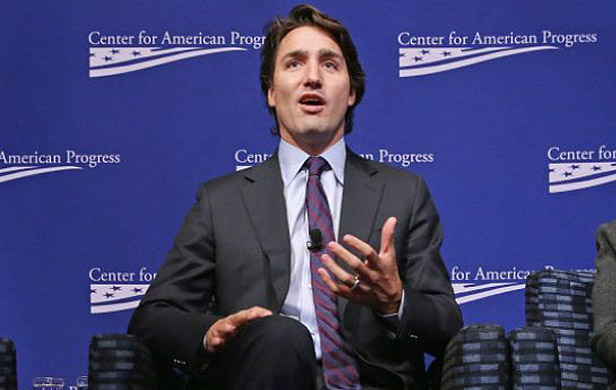
Justin Trudeau addresses a progressive think tank in Washington, DC (photo: Chip Somodevllla/Getty)
Justin Trudeau wants to project a young, fresh face, representing all the good things that Canadians want – a man who would do politics differently.  But the gap between reality and fairytale is extraordinary.
If one looks at what he has said to date, one finds a man with tired old ideas;  a limited understanding of, and sensitivity for, many major issues; and a puppet serving Bay Street, Big Oil and other powerful interests. The same powerful interests served by the Harper administration.

A middle class fairy tale

Most telling is Trudeau’s supposed concern for the middle class.  Though 80% of Canadians have seen their revenues decline or stagnate over the last 3 decades – income inequalities are at an all time extreme – Trudeau, like Stephen Harper, has concluded that low corporate taxes are the way to go for maintaining what they perceive to be a prosperous and rich Canada.
But Trudeau goes one step further to the right than Harper.  He has repeatedly expressed the view that now is not the time to lower the corporate tax rate, implying that, at a later time, a lower corporate tax rate could be an option.
To put all this in context,  the lowering of corporate tax began with the Liberals and was accelerated by the Conservatives.  The result is that: 1) At 15%, Canada has the lowest corporate tax rate in the G8; and 2) approximately $575B lies dormant in corporate liquidity.
Together, these factors imply that having the lowest corporate tax offers very few competitive advantages and that a better distribution of the wealth could be achieved with higher corporate taxes and fewer fiscal escape clauses/deductions.  The additional accrued revenues could be invested in economic development and regional diversification; youth employment; health; innovation for the jobs of tomorrow; public transportation and other urban infrastructure; day care -  to name just a few examples.
Further on this theme, Kevin Page, the former Parliamentary Budget Officer, concluded that a low corporate tax rate limits government manoeuvrability to that of austerity budgets.
In his own clumsy fashion, Trudeau has confirmed Kevin Page’s analysis in that he recognizes that the Liberal Party of Canada’s (LPC’s) own Harper-like policies on wealth distribution would produce Harper-like results. To be more specific, to prepare Canadians for such an eventuality, or the “necessity” of this Bay Street accommodation, Trudeau has indicated that the post election LPC budget could  very well be an austerity budget.
In other words, there is a disconnect between Trudeau’s supposed concern about the middle class and reality. In the absence of any serious attempt at redistribution of the wealth – something in which Trudeau appears not to believe in – he can only offer a middle class fairy tale.  This is a backdrop for many Trudeau’s positions on other issues.
No wonder Justin has described income splitting as “a decent idea”, even though 85% of Canadians would receive no benefit, while the majority of the top 1% of income earners would get $6500 and up.  So much for his preoccupation with the middle class.

Appeasing Big Oil, denying science

Turning to the environment, once again Trudeau has much more in common with Harper than most think, particularly when it comes to the denial of scientific evidence. It’s high time to debunk the myths about Trudeau’s “concerns” in this domain.
Trudeau’s position on Keystone XL is case in point.  According to Justin, the opposition to Keystone XL to transport tar sands bitumen to the US Golf coast is not based on scientific evidence.  Yet life-cycle emissions related to tar sands – from the extraction stage to the refining and production of major quantities of the by-product pet coke for use as a cheap, dirty fuel; and to the final consumption as fuels – place tar sands-derived substances in the range of 20% to 25% more emissions than those associated with conventional petroleum.
As if this extreme denial is not enough to put Trudeau in the same Big Oil camp as Harper, Trudeau has also complimented Premier Redford for promoting Keystone XL with references to Canada’s good environmental record!  Trudeau has been critical of Harper for not doing the same – despite Harper’s disastrous environmental legacy.
This is absolutely astounding!  After Harper’s dismantling of environmental protection legislation, weakening of the environmental impact analysis process, muzzling scientists, decimation of Canada’s environmental research capabilities especially as it relates to the impacts of climate change and the monitoring of Canada’s emissions, pulling out of the Kyoto Protocol,  and much much more, Trudeau, like Harper, perceives the environment as a PR challenge rather than a Mother Earth/humanity state of health challenge.
But the denial doesn’t stop there.  Trudeau bases part of his support for Keystone XL, as is the case with Stephen Harper, on the recent US Dept of State report which suggests that the environmental impacts pertaining to the approval of Keystone XL will be minimal.
Never mind that this report was written by authors close to the petroleum industry who concluded that if the US cannot import unrefined tar sands derivatives, the US would get it’s petroleum from elsewhere.
Never mind that a rejection of Keystone  XL would be a US and global game-changer, sending a clear signal to the globe that the US is serious about reducing its dependency on fossil fuels and will be looking to clean tech to address tomorrow’s energy needs.
Indeed, under these circumstances, it should come as no surprise that Trudeau did not distant himself from Jean Chrétien’s January 2014 remarks to the effect that it makes no sense to restrict tar sands development because we are going to need petroleum for a long time to come.

Falling behind Europe on emissions reduction, green economy

And the denial goes a notch higher when it comes to Trudeau’s views on national solutions to address climate change.  In keeping with the Liberals’ conciliatory legacy with Big Oil, this time, in reference to cap and trade, he claims that this environmental concept doesn’t have scientific merit. (Cap and trade is a model which penalizes companies that exceed their emissions limits and rewards companies that reduce emissions below their targets by being able to sell their credits to firms in the proceeding category.)
Never mind that Europe has had an Emission Trading Scheme (ETS) since 2005 and that the ETS has proven to be a potent compliment to other environmental policies. The results are such that at least 25 EU nations have been identified as likely to meet or beat the EU target 20% reduction of emissions by 2020, relative to 1990 levels.
Never mind that Germany has exceeded it’s Kyoto Protocol goal of a 21% reduction in emissions by 2012 with an achievement of a 25% reduction, all while having one the world’s strongest economies and a clean tech sector that has become bigger than the German auto sector.
Never mind that China has become the world’s largest investor in clean tech - with $67.7B and $61.3B invested in renewables in 2012 and 2013, respectively – and is now planning to introduce the first of seven pilot cap and trade schemes in Shenzhen.
As a former Government of Canada employee who worked in the field of sustainable development, it comes as no surprise that Trudeau’s “thinking” on Big Oil is both conciliatory and wishy-washy.  Emissions spiked up during the previous Liberal reign – as has been the case with the Conservatives at the helm.

The Liberals’ oil-friendly legacy

This LPC legacy was so because of, among other things: 1) the absence of effective legislative and fiscal measures; 2) the party’s continuation of generous subsidies for the fossil fuel sectors; and 3) a fossil fuel-friendly mindset as reflected in the Stéphane Dion proposal, prior to the Liberals’ defeat, to invest billions of government funds in the fossil fuel industry to help that “impoverished” sector reduce its emissions.
It is becoming increasingly evident that Trudeau is vague as to his environmental plans because of his alignment with Big Oil, a longstanding Liberal tradition.

Poor judgement, top-down leadership and Harper similarities

Further on the denial of science,  but in a different context, is the matter of the unusually long time – over a year – that it is taking for Health Canada to approve for use in Canada the drug  Mifepristone (a.k.a. RU-486), the abortion drug.  This, despite the fact that the drug has been in use around the world since 1988, when it was first approved in France.
Given the views on abortion of the minister in question, Rona Ambrose, the delays are suspect. But all Justin Trudeau could say on the exceptional delays is that he is not a medical expert.  Imagine the implications of him being in power with his weak judgement, when this is combined with his not wanting to upset Big Pharma and right wing groups.
Equally telling on Trudeau’s poor judgement and flippancy, was his “performance” on the Radio-Canada TV show Tout-le-monde-en-parle, on Feb 23, 2014.  The Ukrainian Ambassador to Canada, Vadym Prystaiko, quite aptly called for Trudeau to apologize for his “joke” on the show to the effect that Vladimir Putin would not be in a good mood to discuss the Ukrainian turn of events  because of the defeat of the Russian men’s hockey team in Sochi.  As the Ambassador said, 82 deaths in the clashes between security forces and the demonstrators is no laughing matter.

Trudeau’s lightweight Senate proposal

As for the Senate, I have saved this for near the end because I think we should go beyond the scandals of the moment, to the stuff that has implications for all Canadians. Let’s get real. The case has yet to be made as to why a different Senate, made up of unelected officials and appointed by another group of unelected officials, would improve Canadian democracy.  More important, with Senate retirements not mandatory until age 75, it means it would take at least two decades before this so-called different Senate would take shape.
Add to the Trudeau Senate cocktail the way in which he went about springing the news on “Independent” former Liberal Senators. Here one discovers Harper-style, top-down leadership, with no consultations outside a small inner circle. Due to the absence of internal consultation, Trudeau not only surprised Liberal Senators, but his entire caucus!  Or is this another case of poor and gratuitous judgement?

Justin opposes divisive politics – except when it suits him

While Justin Trudeau presents himself as a uniter, not a divider like Harper and Quebec Premier Pauline Marois, delegates at the Feb 2014 national convention in Montreal expressed the view that a Marois majority would help the party gain votes in BC and Ontario. In other words, the LPC hopes for a PQ majority in order to falsely represent the LPC in English Canada as the saviour of national unity. This is wedge politics that places party interests above national interests in order to target specific regional voters. This is the kind of traditional LPC trick that turns off Québécois.
No wonder only 10% of the LPC delegates at their convention in Montreal, Quebec were from Quebec.
During the orange wave in Quebec, the NDP gains were in part the result of former Bloc voters shifting over to the federalist NDP.  This is the way to unite Canadians, by presenting a progressive alternative for all parts of Canada – with the same themes/messages in every region of the country.

Trudeau and Harper: Other similarities

Finally, there are a host of other matters where we find Trudeau and Harper very much on the same page – such as Trudeau’s views that: 1) the sale of Nexen would pave the way for free trade with China and a more prosperous middle class; 2) health is primarily a management issue, rather than a financial challenge; and 3) guns are an integral part of Canadian culture.
Summing up the LPC policy positions to-date, it is clear is that Stephen Harper and Justin Trudeau are on the same Bay Street/Wall Street, Big Oil team.
Why would we expect anything different from Justin in 2015?